



Skip Content [accesskey = 2]

Frequently Asked Questions

DISCLAIMER: This information is intended for educational purposes only. No reliance, expressed or implied, may be made on the information on this page or on any of its links. Any persons considering applying for a medical marijuana card in the State of Colorado should consult an attorney first. This webpage and its related links do not advocate that anyone violate state or federal law. Sensible Colorado is not responsible for any damages incurred as a result of your reliance on the educational information on this page.

Other Information including finding a Doctor, Lawyer, etc

HOW CAN I FIND A DOCTOR OR A CAREGIVER?

Finding a doctor is the first and most important step in becoming a legal medical marijuana patient. Sensible Colorado feels the safest and most responsible thing to do is to talk with your current doctor about medical marijuana. You should consider approaching your doctor in the following manner.

  1. Explain to the doctor your condition and that you qualify for medical marijuana under state law. Tell your doctor that you are suffering from one of the illnesses or symptoms that allow you access to medical marijuana in Colorado. These conditions are listed here: http://www.cdphe.state.co.us/hs/medicalmarijuana/marijuanafactsheet.asp
  2. Tell your doctor about your experiences using conventional medicine (not marijuana) and how those medicines did not help. Tell the doctor (if appropriate) that you have used marijuana before and it has helped with your condition.
  3. Present your doctor with a copy of Colorado’s medical marijuana law. You can print this off at: http://www.cdphe.state.co.us/hs/medicalmarijuana/mjamendment.htm
  4. Ask your doctor to write you a recommendation for medical marijuana. This recommendation form can be printed off here: http://www.cdphe.state.co.us/hs/medicalmarijuana/medicalmarijuanaforms.asp

If you have further questions or would like more information about medical marijuana and your illness please contact Sensible Colorado.

Sensible Colorado can help direct you towards a doctor, however, we do not refer people to caregivers or dispensaries. As noted in the section on caregivers above, there are no special requirements to become a caregiver other than having significant responsibility for managing the patient’s well-being.

GROWING/DISPENSING COLLECTIVES, COOPERATIVES, AND COMPASSION CLUBS

Colorado law does not explicitly address the issue of patients and caregivers joining together to form cannabis collectives or cooperatives to more effectively grow and dispense medicine to patients. The sale or distribution of marijuana remains illegal under federal law, even for strictly medical purposes.

In U.S. v. Oakland Cannabis Buyers’ Cooperative, the federal government challenged the ability of medical marijuana distribution centers to provide patients with marijuana. In 1999, the Ninth U.S. Circuit Court of Appeals ruled 3-0 that “medical necessity” is a valid defense against federal marijuana distribution charges if a distributor can prove that the patients it serves are seriously ill, face imminent harm without marijuana, and have no effective legal alternatives.

In 2001, the US Supreme Court overturned the 9th Circuit and held there is no medical necessity defense for marijuana manufacture and distribution. However, as noted, the Supreme Court did not decide if there might still be a medical necessity defense for individual patients possessing marijuana for medical purposes.

Parties interested in starting a medical marijuana cooperative/collective should consult with an attorney or Sensible Colorado for more information. There are numerous legal pitfalls that make such an endeavor ripe with problems. Carelessly starting a medical marijuana cooperative/collective could subject the operators of such an establishment to serious state and federal felony prosecution, regardless of whether the operators are licensed medical marijuana patients.
See also this list of support/discussion groups in Colorado.

HOUSING EVICTION

Landlords may attempt to evict licensed medical marijuana patients from their rental homes or apartments based on growing or possessing medical marijuana even though such activities are legal under state law. In addition, local city attorney’s have the power to attempt to coerce landlords to evict medical marijuana patients based on a theory that such activities create a public nuisance. Under federal law, ANY marijuana use in federally subsidized housing is prohibited. Patients with questions or concerns about housing issues should contact one of the attorneys listed on this website.

As discussed above, you will need to decide whether or not to be honest with your landlord about your activities. If you decide not to tell your landlord, you should consider making sure that your landlord will always provide you with at least 24 to 48 hours notice before entering your rented premise. Most residential leases do not automatically include such a provision. Therefore, you will need to write such a provision into your lease and make clear to your landlord that you want advance notice to protect your privacy.

Patients experiencing the threat of eviction should consult with an attorney or Sensible Colorado to determine the appropriate course of action.

EMPLOYMENT

Colorado law does not provide any special protections or rights for medical marijuana patients in relation to their employment. Employment in Colorado is generally on an “at-will” basis, meaning that employers generally have the right to fire employees at any time for any reason (other than for discriminatory or retaliatory reasons). In addition, many employers have drug testing programs. Even if you are a licensed medical marijuana patient, an employer may still require you to take a drug test, and may still fire you for a positive test. Some employees are hired with employment contracts. Employment contracts can be negotiated to protect a medical marijuana patient from being fired based on use of their medicine. If you have questions about this issue, consult with Sensible Colorado or your own attorney for more information.

DRIVING OR TRAVELING TO OTHER STATES WITH MEDICAL MARIJUANA

Currently, Colorado’s medical marijuana cards are only recognized as valid in Montana and Rhode Island.  In all other states, including other states that have medical marijuana programs such as California, a person in possession of a Colorado medical marijuana card will not get any protections from criminal prosecution. In addition, patients should be cautious if driving between states because there are no protections for patients licensed under Colorado state law while driving through other states.

In addition, there are no protections for medical marijuana patients flying on commercial airplanes. Federal agents can and will seize medical marijuana and arrest the patient attempting to board a plane if they find the patient’s medicine. Moreover, there are no protections for patients flying internationally. Most international airports have drug dogs that can locate medical marijuana in bags.

MEDICAL MARIJUANA SCHOLARSHIP PROGRAM

Sensible Colorado is looking for donors to assist in establishing a scholarship program to provide low income medical marijuana patients with a scholarship to pay the $90 filing fee for the medical marijuana license.  TO DONATE TO THIS PROGRAM PLEASE MAIL YOUR CONTRIBUTION TO:

Sensible Colorado
MMPF (Medical Marijuana Patient Fund)
Mail: P.O. Box 18768
Denver, CO 80218-0768
Sensible Colorado is a 501(c)(3) non-profit organization. All donations are tax deductible.

You can also donate to Sensible Colorado online.

REFORM AT THE STATE LEVEL

Sensible Colorado does not attempt to influence state legislation. However, the Colorado legislature could enact further legislation to clarify the rights and responsibilities of medical marijuana patients under state law. For example, the legislature could enact legislation increasing the limit on the number of plants to more realistically reflect the needs of most medical marijuana patients. In addition, the legislature could enact legislation to clarify the legality of medical marijuana cooperatives under state law. The legislature could clarify the power of primary caregivers to manage more than 5 patients at one time. Similarly, the Health Department could create new policy or enact binding regulations clarifying the issues identified above and others.

SOLUTIONS TO THE MEDICAL MARIJUANA ILLEGALITY UNDER FEDERAL LAW

The best solution to end the conflict between federal and state medical marijuana laws would be for Congress to change federal law to allow states to legalize the medical use of marijuana free from federal prosecution. To date, all such legislative efforts have been unsuccessful.
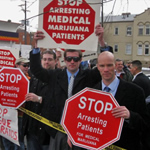
For several years, Congress has been considering the Hinchey-Rohrabacher Amendment, which would order the DEA to stop arresting and imprisoning state licensed medical marijuana patients. You should consider contacting your local US Congressperson to share your views on this issue.
Another option would be for the federal government to reschedule marijuana to something lower than a Schedule I drug. A Schedule I drug is a drug defined as having a high potential for abuse or addiction and no known medical value. Doctors cannot prescribe Schedule I drugs. Medical marijuana is the exact opposite of a Schedule I drug: it is rarely addictive and has many medical uses. However, the federal government has resisted rescheduling marijuana for years. US Representatives Barney Frank and Cynthia McKinney have introduced a bill to reschedule marijuana to Schedule II to allow it to be prescribed by doctors. You could consider calling your US Congressperson and expressing your position on marijuana rescheduling.

ATTORNEY CONTACTS

Sensible Colorado
Brian Vicente, Esq.
PO Box 18768
Denver, CO 80218
(Ph) 720 890 4247
Email: brian@sensiblecolorado.org

Sean T. McAllister
McAllister Law Office, PC
PO Box 3903
Breckenridge, CO 80424
(Ph) 970-393-3164
Email: mcallisterlaw@msn.com

Robert Corry
600, 17th Street, Suite 2800 South Tower
Denver, Colorado 80202
(Ph) 303-634-2244
Email: robert.corry@comcast.net

Kristopher L. Hammond
Hammond Law Offices
P.O. Box 774425
1041 Lincoln Avenue
Steamboat Springs, CO 80477
(Ph) 970-879-6060
Email: klh@yampalaw.com

Dr. Bob Melamede, Ph.D.: www.uccs.edu/~rmelamed/
Colorado Department of Public Health and Environment: http://www.cdphe.state.co.us/hs/medicalmarijuana/marijuanafactsheet.html
Americans for Safe Access: www.safeaccessnow.org
Marijuana Policy Project: www.mpp.org
SAFER: www.saferchoice.org